Here is the consistent timeline in order from the burial of Jesus, to His ascension 40 days later.
Many women from Galilee follow Joseph and Nicodemus to see Jesus laid in the tomb. Magdalen and the other Mary are specifically mentioned. (John 19) (Mark 15) Afterward that evening, some of the other women go home to prepare spices and ointments for Jesus' body. (Luke 23)
The next day on the high Sabbath, the chief priests go to Pilate for a guard on the tomb. (Matthew 27)
In the night, there's another earthquake, and an angel in appearance as lighting rolls away the stone, making the soldiers become as dead. (Matthew 28) Jesus either resurrects at this time, or any time during the night beforehand. At some time in the night, the guards awaken and depart the empty tomb, to report to the chief priests.
Magdalen comes later in the dark before dawn, and finds the tomb empty. She tells Peter and the other disciple, and they come running to see the tomb empty. They enter to see and depart. (John 20)
Magdalen remains behind and sees two angels in the tomb, and then Jesus Himself alive outside the tomb. She is the first person on earth to see Him after His resurrection. While still dark, she returns again to tell the disciples of His resurrection, and they don't believe it. (John 20) (Mark 16)
Magdalen, the other Mary, Salome, and the other women from Galilee, including Joanna, arrive at the tomb in the morning light. One group arrives with their prepared spices and ointments, while Magdalen's group arrives with bought sweet spices. They find the tomb empty. (Mark 16) (Luke 24)
Magdalen, the other Mary, and Salome are met by the angel that rolled away the stone, and are told to see in the tomb where the Lord had lain. Another angel sitting therein tell them to tell the disciples to go to Galilee to see Jesus. (Matthew 28) (Mark 16) The other women including Joanna enter the tomb and see no one, and while standing outside are met by two more angels, that send them also to the disciples to go to Galilee to meet Jesus. (Luke 24)
All the women depart and en route meet Jesus, and hold His feet in worship. He also sends them all to tell the disciples to meet Him in Galilee. They all then tell the disciples these things, and they don't believe it. (Matthew 28)
Peter runs to the tomb a second time and ponders these things. (Luke 24)
Jesus next appears to Cleopas and another disciple on the road to Emmaus, and later toward evening they recognize Him at table, and He vanishes from their sight. In that hour, they go to the eleven to tell them of Jesus' resurrection. They don't believe it. Luke 24) (Mark 16) Peter has now also seen the Lord Jesus. Paul reports that Jesus also appeared to James at some time.
At evening, Jesus now first appears to the disciples with the others in the their midst, and shows He is indeed resurrected bodily from the dead, and not only a spirit, by showing His hands and side, and eats some fish. Thomas is not with them. (Luke 24) (John 20)
8 days later, He appears to the eleven with Thomas as they sat at meat, and upbraids them for their unbelief, and also challenges Thomas to insert His fingers into his hands, and his hand into Jesus' side. (Mark 16) (John 20)
Afterward on another day, Peter goes a fishin' at the sea of Galilee with 6 other disciples, including Thomas, Nathanael, the sons of thunder, and 2 other disciples. For the third time after His resurrection, Jesus meets His disciples on the Galilee shore with food on a fire. They all know Him. (John 21)
Afterward on another day, all the disciples meet Jesus at the Galilee mount, that He had appointed them, and worshipped Him. Some doubted what to do. (Matthew 28)
On the 40th day after His resurrection, He leads all the disciples and many others to Bethany on Mt Olivet. (Luke 24) (Acts 1) There He gives His great commission with promise of the Holy Ghost, and ascends to heaven to be recieved up in a cloud. The disciples remain standing and looking upward for Jesus, until two angels come to remind them to go to Jerusalem, and wait for the promise of the Father.
These are a consistent order of events from the 4 gospels and Acts 1.
Paul confirms Peter saw the Lord first before the other apostles, on the evening of the first day of His resurrection, and that above 500 saw Him during the 40 days after. He was also seen by James after the evening of the first day, either before His second appearance to them on the 8th day, or afterward before the sea of Galilee for the third time.
The consistent events from Jesus' burial to His ascension
Moderator: Moderators
Re: The consistent events from Jesus' burial to His ascension
Post #101The record does say Magdalene with at the tomb in the dark before morning light. If you have a record of anyone else being with her, then quote it.JehovahsWitness wrote: ↑Thu Jan 08, 2026 6:46 pmYou're setting yourself up for all kinds of difficulties that can be avoided if you don't read more into the narrative more than is necessary. John does not say Mary's first visit was "alone" ;
The record does say she was the first person to see Jesus risen from the dead.
Vital? The vital thing they had, was the things to anoint the dead body. Magdalene was already dismissed out of hand by the apostles, for telling them Jesus had risen. So the women were then going to counter the apostles and believe her, and leave behind their vital precious ointments to honor Jesus' dead body? That would have been an act of rebuke to the apostles' unbelief.JehovahsWitness wrote: ↑Thu Jan 08, 2026 6:46 pm indeed to not contradict the other narratives (or imply the difficult scenario of her deliberately keeping vital information from her female companions)
This is explained enough already.
He was certainly focusing on the fact that Magdalene was there at dark before dawn.JehovahsWitness wrote: ↑Thu Jan 08, 2026 6:46 pm we have but to accept that John only mentions Mary because he is focusing on her story.
Show any record of anyone else with her coming to the tomb in the dark. And then show why she was the only one at that time, to first see Jesus alive again before anyone else.
Magdalene being there alone at dark and first seeing Jesus alive, is what harmonizes the other accounts.JehovahsWitness wrote: ↑Thu Jan 08, 2026 6:46 pm If John had said the word "alone" then we would have to seek other means to harmonize the accounts
Ok, so now you're resorting to lying.JehovahsWitness wrote: ↑Thu Jan 08, 2026 6:46 pm but John does not , he is silent as to who else may or may not have been with Mary at her initial visit. Since the other accounts mention Mary M. with the women and at a pre-dawn visit
All accounts with the women together is at beginning of dawn, and very early in the morning. Not in predawn darkness.
You were at least remaining honest, if in denial, when trying to argue Magdalene may not have been alone in the dark before dawn.
Your web of deceit already tangled so fast? There were other women with her at a predawn visit, but now only a supposed pre-dawn visit.JehovahsWitness wrote: ↑Thu Jan 08, 2026 6:46 pm
If we have Mary WITH the other women and running off BEFORE the first angelic visit, we have her not withholding what she learnt from a supposed "predawn" visit , namely that the stone had already been rolled away.
Duh. Sort of included in the body now risen from the dead, and outside the closed tomb.JehovahsWitness wrote: ↑Thu Jan 08, 2026 6:46 pm
NOTE If she had visited earlier and noted that the stone had been rolled away (barring her being too scared to even peer inside) she would have been withholding the information that THE BODY was also gone.
Correct. All at beginning of early morning dawn.JehovahsWitness wrote: ↑Thu Jan 08, 2026 6:46 pm
HOW MANY WOMEN VISITED THE TOMB?ANSWER: At least six: two Marys, Salome, Joanna and "other women" (plural, ie an addition minimum two others ).
- Matthew: Mary Magdalene and the other Mary (28:1)
Mark: Mary Magdalene, the mother of James, and Salome (16:1)
Luke: Mary Magdalene, Joanna, Mary the mother of James, and other women (24:10)
John: Mary Magdalene (20:1)
Only one at predawn dark.
http://debatingchristianity.com/forum/v ... 33#p926933JehovahsWitness wrote: ↑Thu Jan 08, 2026 6:46 pm
What TIME of day did the women first visit the tomb?
Other than Magdalene, at beginning of early morning dawn.
If it doesn't include Magdalene's predawn visit, and first seeing Jesus alive again outside the tomb. Then it's just more concocted efforts to jam the puzzle together without the first primary pieces in place.JehovahsWitness wrote: ↑Thu Jan 08, 2026 6:46 pm To read more please go to other posts related to...
THE RESURRECTION , JESUS RESURRECTION and ... RESSURECTION CHRONOLOGY
Not interested.
Re: The consistent events from Jesus' burial to His ascension
Post #102By showing any error of contradiction in the written record, of course.William wrote: ↑Fri Jan 02, 2026 6:11 pm [Replying to RBD in post #1]
How are we to ascertain that this whole story wasn't a useful fiction created through a combined effort of Roman and Jewish intellectuals designed to influence the masses?
How are we to ascertain if someone has shown this whole story is a useful fiction created through a combined effort of Roman and Jewish intellectuals designed to influence the masses?
By showing any error of contradiction in the written record, of course.
How are we to answer if someone believes this whole story is a useful fiction created through a combined effort of Roman and Jewish intellectuals designed to influence the masses, without showing any error of contradiction in the written record?
Who cares?
-
William

- Savant
- Posts: 16490
- Joined: Tue Jul 31, 2012 8:11 pm
- Location: Te Waipounamu
- Has thanked: 1037 times
- Been thanked: 1950 times
- Contact:
Re: The consistent events from Jesus' burial to His ascension
Post #103[Replying to RBD in post #102]
A worthwhile practice is if one starts a thread, one stays aware of what is discussed in said thread. The question was answered and way better than what you have now replied here - 101 posts later. The discussion moved into even better material so whatever it is you are now doing, and whatever reason you had for creating this thread in the first place ... "who cares" indeed.

A worthwhile practice is if one starts a thread, one stays aware of what is discussed in said thread. The question was answered and way better than what you have now replied here - 101 posts later. The discussion moved into even better material so whatever it is you are now doing, and whatever reason you had for creating this thread in the first place ... "who cares" indeed.

The question has never been whether God is speaking. The question has always been whether there is anyone listening - anyone who has stopped hiding long enough to hear.
-
JehovahsWitness

- Savant
- Posts: 23438
- Joined: Wed Sep 29, 2010 6:03 am
- Has thanked: 930 times
- Been thanked: 1349 times
- Contact:
Re: The consistent events from Jesus' burial to His ascension
Post #104RBD wrote: ↑Tue Feb 24, 2026 5:02 pmThe record does say Magdalene with at the tomb in the dark before morning light. If you have a record of anyone else being with her, then quote it.JehovahsWitness wrote: ↑Thu Jan 08, 2026 6:46 pmYou're setting yourself up for all kinds of difficulties that can be avoided if you don't read more into the narrative more than is necessary. John does not say Mary's first visit was "alone" ;
The record does say she was the first person to see Jesus risen from the dead.
The word "alone" is not in the narratives ; that may or may not be a reasonable assumption (depending on whether or not they conflict with other relavent statements), but they it remains an assumption nonetheless.
Remember : Absence of evidence is not evidence if absence.
Mary may well have been alone when she first travelled to the grave but in the absence of an explicit statement to that effect, to say that the bible says something when it is merely your considered conclusion, is premature.
That is true, John did say this... but could there be a better explanation for how this came about than Mary going on a solo night visit and meeting the Lord before the women set out with spices ?
I was not suggesting that the mention of "predawn" was a direct quote, rather as stated earlier, a logical conclusion see below. see further below.
Last edited by JehovahsWitness on Wed Feb 25, 2026 8:32 am, edited 2 times in total.
INDEX: More bible based ANSWERS
http://debatingchristianity.com/forum/v ... 81#p826681
"For if we live, we live to Jehovah, and if we die, we die to Jehovah. So both if we live and if we die, we belong to Jehovah" - Romans 14:8
http://debatingchristianity.com/forum/v ... 81#p826681
"For if we live, we live to Jehovah, and if we die, we die to Jehovah. So both if we live and if we die, we belong to Jehovah" - Romans 14:8
-
Athetotheist
- Prodigy
- Posts: 4026
- Joined: Sat Nov 02, 2019 5:24 pm
- Has thanked: 20 times
- Been thanked: 724 times
Re: The consistent events from Jesus' burial to His ascension
Post #105[Replying to RBD in post #101]
Going back to Mark, if you have a record of Magdalene withholding a previous trip to the tomb from the other women, then quote that.The record does say Magdalene with at the tomb in the dark before morning light. If you have a record of anyone else being with her, then quote it.
"The religious idea of God cannot do full duty for the metaphysical infinity."
---Alan Watts
---Alan Watts
-
JehovahsWitness
- Savant
- Posts: 23438
- Joined: Wed Sep 29, 2010 6:03 am
- Has thanked: 930 times
- Been thanked: 1349 times
- Contact:
Re: The consistent events from Jesus' burial to His ascension
Post #106QUESTION When did the women arrive at the tomb?
# But does John not state the women ARRIVED at the tomb while it was still dark?
John's narrative reads as follows:
While in English "came" and "arrived" in the simple past tense can be synonyms (she came at 5am /she arrived at 5am), even in the english, the shift to present tenses (she is coming/she comes) refers to the motion or movement towards a destination which has yet to be completed. Notice now how the Greek literally reads:
To the but one [day] of th Sabbath Mary the Magdalene is coming (Greek erchomai) early of darkness yet being into the memorial tomb
So John didn't actually write "she came" (simple past) he wrote "she is coming" Greek present tense. While using the English past simple is a perfectly acceptable translation since the narrator is describing a story set in the past, what John actually wrote in Greek can be descrubed as "a historical present tense", meaning using the present tense to get the reader/hearer to imagine that they are in the story (that happened in the past) and are witnessing the action as it happens. We do a similar thing with jokes today ("Man walks into a pub, the bartender turns to him and says "what can I get you? ...") In other words strictly speaking John doesn't write Mary arrived at the tomb while it was still dark (a completed action, focusing on the end result, which is what a perfect tense would convey) but rather refers to her "coming" ie travelling (progressive action) in the dark. In short the scripture is far too ambiguous to say categorically that he meant it was dark when Mary arrived at the tomb and thus cannot represent any kind of contradiction to the other gospel narratives.
QUESTION Is it dark at dawn?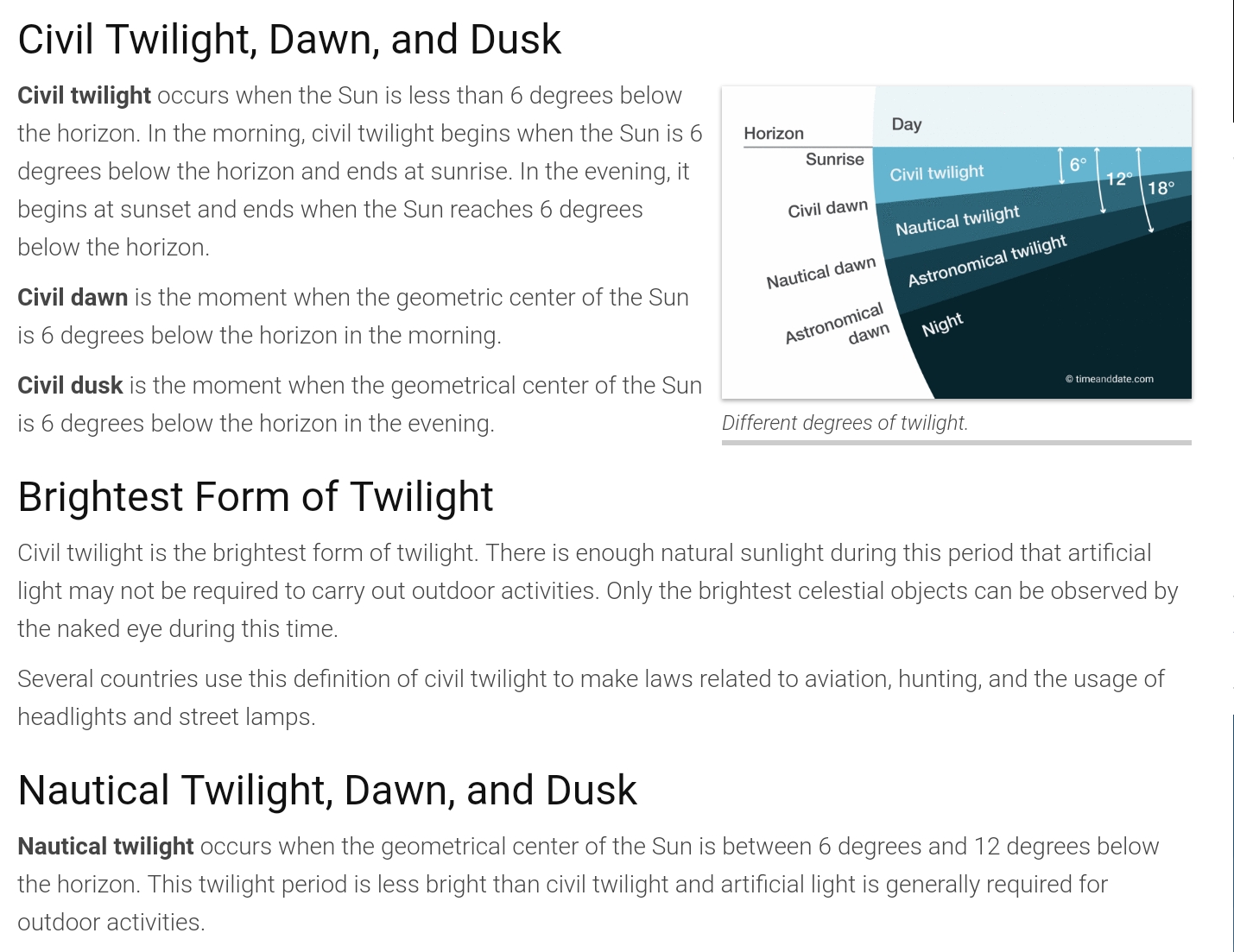
Source: https://www.timeanddate.com/astronomy/d ... light.html
Keeping in mind the "coming" to the tomb can refer to the journey as well as the arrival (see above) the biblical narratives can legitimately cover "astronmical" "Nautical" and "civil" dawn with no contradiction, especially if each writer chose to focus on a different aspect of the mornings events with them journeying ("coming") during "astronomical dawn" (when for all intense and purposes it is "dark") and arriving at civil dawn or sunrise no doubt meaning either when artificial light would no longer be needed or when any part of the sun could be seen above the horizon).
# But it's not dark at sunrise!
FURTHER READING
Greek Tenses - Insight on the scriptures Vol I p. 1006
https://wol.jw.org/en/wol/d/r1/lp-e/1200001767
Coming & Going in Kline Greek: Deixis & Aspect of erchomai by AJ Espinosa
- The women setting out in the pre-dawn darkness and arriving at the tomb just as the sun was rising well harmonize the various accounts.
# But does John not state the women ARRIVED at the tomb while it was still dark?
John's narrative reads as follows:
JOHN 20:1: "On the first day of the week, Mary Magalene came to the tomb early while it was still dark, and she saw that the stone had already been taken away from the tomb". NWT
While in English "came" and "arrived" in the simple past tense can be synonyms (she came at 5am /she arrived at 5am), even in the english, the shift to present tenses (she is coming/she comes) refers to the motion or movement towards a destination which has yet to be completed. Notice now how the Greek literally reads:
To the but one [day] of th Sabbath Mary the Magdalene is coming (Greek erchomai) early of darkness yet being into the memorial tomb
So John didn't actually write "she came" (simple past) he wrote "she is coming" Greek present tense. While using the English past simple is a perfectly acceptable translation since the narrator is describing a story set in the past, what John actually wrote in Greek can be descrubed as "a historical present tense", meaning using the present tense to get the reader/hearer to imagine that they are in the story (that happened in the past) and are witnessing the action as it happens. We do a similar thing with jokes today ("Man walks into a pub, the bartender turns to him and says "what can I get you? ...") In other words strictly speaking John doesn't write Mary arrived at the tomb while it was still dark (a completed action, focusing on the end result, which is what a perfect tense would convey) but rather refers to her "coming" ie travelling (progressive action) in the dark. In short the scripture is far too ambiguous to say categorically that he meant it was dark when Mary arrived at the tomb and thus cannot represent any kind of contradiction to the other gospel narratives.
QUESTION Is it dark at dawn?
- The chart illustrates that if we take "dawn/sunrise" to be a general term describing the period during which night transitions to day, the degree of light actually goes through several stages at least two of which would probably be described generally as "dark" ie there not being enough natural light to go without some kind of artificial lighting for some activities.
Source: https://www.timeanddate.com/astronomy/d ... light.html
Keeping in mind the "coming" to the tomb can refer to the journey as well as the arrival (see above) the biblical narratives can legitimately cover "astronmical" "Nautical" and "civil" dawn with no contradiction, especially if each writer chose to focus on a different aspect of the mornings events with them journeying ("coming") during "astronomical dawn" (when for all intense and purposes it is "dark") and arriving at civil dawn or sunrise no doubt meaning either when artificial light would no longer be needed or when any part of the sun could be seen above the horizon).
# But it's not dark at sunrise!
- Nobody said it was. John does not mention sunrise he speaks of darkness as Mary came (was coming - see explanation of the Greek above). The only narrative that speaks specifically of "sunrise"is Mark who presumably was refering to the end of their journey.
FURTHER READING
Greek Tenses - Insight on the scriptures Vol I p. 1006
https://wol.jw.org/en/wol/d/r1/lp-e/1200001767
Coming & Going in Kline Greek: Deixis & Aspect of erchomai by AJ Espinosa
INDEX: More bible based ANSWERS
http://debatingchristianity.com/forum/v ... 81#p826681
"For if we live, we live to Jehovah, and if we die, we die to Jehovah. So both if we live and if we die, we belong to Jehovah" - Romans 14:8
http://debatingchristianity.com/forum/v ... 81#p826681
"For if we live, we live to Jehovah, and if we die, we die to Jehovah. So both if we live and if we die, we belong to Jehovah" - Romans 14:8
Re: The consistent events from Jesus' burial to His ascension
Post #107John's the one that puts Magdalene at the tomb in the dark before dawn. All accounts of her with other women are later in the early morning dawn.Athetotheist wrote: ↑Fri Jan 02, 2026 6:47 pm [Replying to RBD in post #8]
That indicates that she still intends to use them, and that indicates that she hasn't been to the tomb earlier to find the body missing.
No, you say she was. You're the one who puts John's account before Mark's, but Mark's account still suggests that she hasn't been to the tomb.False. Record says she was.
I don't argue with people who either don't believe the written record, or don't want to comprehend the difference between darkness before dawn, and morning light of dawn.
Re: The consistent events from Jesus' burial to His ascension
Post #108What I do offer, is a consistent timeline of events from Jesus' crucifixion to His ascension. It begins with the commonly overlooked simple fact, that Magdalene was at the tomb in the dark before dawn, and the first person to see Jesus risen from the dead. The rest falls into place from there.William wrote: ↑Sat Jan 03, 2026 2:22 pm
What RBD wrote, signifies something which is a story about a supposed event which regardless of whether fiction or fact or a mixture of both, leaves the reader with believing it through faith based on the assumption that it must have happened the way it was written, or choosing to work with the known evidence of church history and ask why it actually matters whether one believes the story through faith.
The Bible is not one of paganism's mythical 'noble lies'.William wrote: ↑Sat Jan 03, 2026 2:22 pm If we define a "useful fiction" as a foundational narrative that, regardless of its historical veracity in detail, organizes human perception, motivates behavior, and sustains a social order, then Western Christendom is arguably the most successful and durable example in history.
2Pe 1:16
For we have not followed cunningly devised fables, when we made known unto you the power and coming of our Lord Jesus Christ, but were eyewitnesses of his majesty.
No mythographer takes time within the myth to deny it's a myth.
Re: The consistent events from Jesus' burial to His ascension
Post #109Not sure what this is all about, but the simple answer is, that the intended audience is all readers. Otherwise, it would never have been publicly published.Realworldjack wrote: ↑Sun Jan 04, 2026 12:49 am
The bottom line is, we do not know who the intended audience was, and neither of us can insist one way or the other because it cannot be demonstrated.
Now who the first readers were, is obvious: The fellow Christian believers at the time. Beginning with Theophilus.
Act 1:1
The former treatise have I made, O Theophilus, of all that Jesus began both to do and teach,
This is not to an unbelieving Jew, nor fault-finding Greek. Nor an apologetic to accusers of Jesus Christ.
1Co 12:3
Wherefore I give you to understand, that no man speaking by the Spirit of God calleth Jesus accursed:
Re: The consistent events from Jesus' burial to His ascension
Post #110In this regard, whether others were with her in the dark is irrelevant to it's significance.JehovahsWitness wrote: ↑Wed Feb 25, 2026 8:03 am
The word "alone" is not in the narratives ; that may or may not be a reasonable assumption (depending on whether or not they conflict with other relavent statements), but they it remains an assumption nonetheless.
Remember : Absence of evidence is not evidence if absence.
Mary may well have been alone when she first travelled to the grave but in the absence of an explicit statement to that effect, to say that the bible says something when it is merely your considered conclusion, is premature.
The fact that Magdalene was at the tomb before dawn, clears up the usual conflicts of when she came again with other women at dawn.
If you have one, then of course by all means show how she was the first person to see Jesus alive again at the tomb.JehovahsWitness wrote: ↑Wed Feb 25, 2026 8:03 amThat is true, John did say this... but could there be a better explanation for how this came about than Mary going on a solo night visit and meeting the Lord before the women set out with spices ?
However, the significance of being at the tomb before dark, and then again with others at dawn, still clears up all the inconsistencies, if her first visit was at dawn with others.
All that's happened here, is another great excample of our the simplest solution in apparent Bible 'inconsistency', is usually by overlooking a little fact in the big picture:
Zec 4:10
For who hath despised the day of small things?
I.e. attention to detail...

