
As per the request in this thread, I am starting this thread to debate the question of common descent. I'm perfectly happy to kick off the discussion with a presentation of a tiny slice of the evidence biologists consider established common descent.
Common descent is a historical claim about the evolutionary past of organisms. It refers to the idea that all organisms are related to one another like a gigantic extended family. For example: five million years ago, chimpanzees and humans did not exist separately, but were represented by a single species. Approximately 4.5 million years ago that population underwent speciation and each new species (at that point very similar to one another), gradually diverged. According to all of mainstream biology, this principle holds true for all life, so that every species shares ancestry with every other at some point in the distant past.
To make this claim, biologists have a large amount of evidence that they think establishes common descent as a very robust scientific claim. The famous talkorigins '20+ evidences for macroevolution' article is actually a list of evidence for common descent, and doesn't actually have much to do with macroevolution as modern biology uses the term.
Rather than use that article here, I will instead go strait to the most authoritative sources I have access to, and give a quick summary of the overview of the evidence from Douglas J. Futuymas Evolutionary Biology 3rd edition, the most respected general textbook in the field.
Futuyma lists eight categories of evidence, each of which would require a fair amount of elaboration. I'll give the full list before expanding on one or two.
1. The hierarchical organisation of life.
2. Homology
3. Embryological similarities
4. Vestigial characters
5. Convergence
6. Suboptimal design
7. Geographical distributions
and 8. Intermediate forms.
I'll expand a little on 1 and 8 before throwing open the floor.
Life on earth exists in a nested hierarchy. This means that if you divide organisms into groups according to their features, you can then divide each of those groups into more groups without overlapping. So, if one divides the tetrapods from the arthropods, one can then pick out smaller groups; say, the mammals out of the tetrapods, and the insects from the arthropods, and those groups will not overlap in any new features that are not present in their parent groups. Meanwhile, if you try to group cars first by engine size, and then by colour, you'll find that there is a lot of overlap of features in groups that aren't present in those groups parent categories. So both red cars and blue cars can have both V6 and V12 engines, but triple segmentation with six legs is found only in arthropod groups (namely insects), while milk is found only in tetrapod groups (namely mammals).
This is evidence for common descent, because this pattern of nested hierarchy is produced by a historic pattern of descent and divergence, and by hardly any other types of processes. For example, tracing the surnames in a family tree yields a nested hierarchy: if one branch of the plantaginet family changes its name to plantaginet-smith, then you'll find plantaginet smith only in the larger plantaginet extended family. Only objects that have been produced by descent and branching fall into true nested hierarchies.
This fact about living things allows us to do all sorts of things in the exciting world of molecular biology. Nested hierarchies are what enable us to produce phylogenetic trees of life, which are essentially hypotheses about a particular pattern of descent. Using the same methods we now use to establish paternity from blood samples in court, we establish the relationships of species. The most striking thing is that we can yield the same phylogenetic tree by analysing just about any genetic feature: be it a gene, or mitochondrial DNA, or a particular protein sequence like hemoglobin, or most tellingly, endogenous retroviral insertions (I can expand on this last one if it's unfamiliar), the same tree keeps appearing again and again. This would be inexplicable if all species had separate origins, but is exactly what common descent predicts.
Now, to intermediate forms. Here, I will list the fossilised forms of three major evolutionary lineages, from three of my favourite books. I can't supply the diagrams, obviously, but I will give page numbers for anyone who wants to check up on me.
First, it should be established that according to the scenario of independent creation of organisms, intermediate sequences should not exist at all. Given that, the following three gradual evolutionary sequences establish the evolutionary history of these organisms: lizards to mammals, four-legged artiodoctyls to whales, and hyracotherium to modern horses.
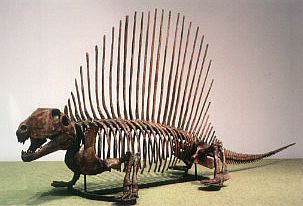
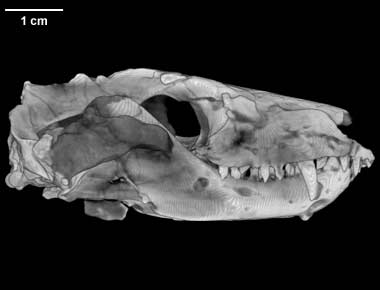
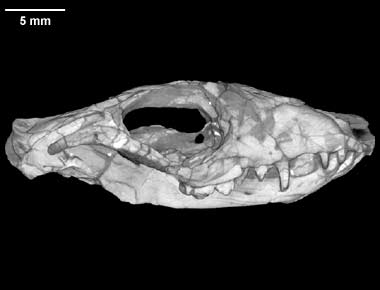
From Ridleys Evolution text: The following fossils form a transitional lineage: Reptilian pelycosaurs to Ophlacodontids (which also gave rise to the famous Dimetrodon ), to the broadly varying Therapsids, from amongst whos number came the Cynodots, representing whom there are many individual specimens, such as(in approximate evolutionary order):
Procynosuchus
Thrinaxodon (here's another thrinaxodon)
Diademodon
Probainognathus
These specimens become increasingly less reptilian and begin to accumulate mammilian features over time. The latest cynodonts in this series blend neatly into the early mammals.
I'm running short on time, so I'll finish whales and horses quickly.
Refer to At the Waters Edge by Carl Zimmer for more information on this graduation from four legged pakicetus to modern whales:
Pakicetus, Ambulocetus, Dalanistes, Rodhocetus, Takracetus, Gaviocetus, Basilisaurus, Dorudon, Mysticetes (modern baleen whales). Googling these names might yield more information as well.
Refer to Strickberger and Monroes' Evolution textbook for more information on the transition from the small 55 million year old Hyracotherium, through the Oligocene Miohippus and Miocene Merychippus to modern Equus. This is a famously well documented transition, so it should be easy to find online resources.
But right now, I've made myself late. I suppose the topic of this debate should be: 'Do these observations, which are commonly advanced by mainstream biology, provide evidence for common descent?'
Good night and enjoy the debate.
The reality or otherwise of Common Descent
Moderator: Moderators
-
Oolon Colluphid
- Student
- Posts: 13
- Joined: Tue Jun 29, 2004 6:41 am
- Location: Hampshire, England
Post #11
Correct (more or less): natural selection does not influence mutation. (The caveat is that some genome regions are apparently much more open to mutations than others, and natural selection probably had a hand in this.) Rather, it affects what mutations (however caused) are found in subsequent generations. So, so what?otseng wrote:From my understanding of evolution, natural selection has nothing to do with genetic mutations. They do work hand in hand to produce evolution, but natural selection does not influence whether genes are mutated or not.Oolon Colluphid wrote: It is because, once you have a phenotype that is well-suited to a particular niche, there is little selection pressure to deviate from that phenotype. In fact, moving away from that form is likely to be punished by natural selection... unless doing so allows success in a different niche. Morphology tracks the requirements of the niche. So if the niche is stable over a long period, so will the phenotype be.
Maybe I was unclear in my previous post thenTherefore, natural selection cannot explain why organisms have not mutated over millions of years.
 . Where have I said that things havent accumulated mutations?
 In the case of the coelacanth, they clearly have changed, presumably through mutations (;)): despite being remarkably similar to fossil versions, modern coelacanths are nevertheless sufficiently different from fossil versions to not even be the same genus. They are separate families.
Similarly, we have ants preserved in Cretaceous amber. They are clearly ants. But they are not modern species by a long chalk.
So Im afraid I dont follow your logic:
Natural selection doesnt cause mutations --> Natural selection doesnt explain long-term phenotypic stability.
Im struggling to find a clearer way to put this than I already have...
Suppose that one thing an organism needs in its niche is aquatic streamlining.
Suppose that, over many generations, it achieves good aquatic streamlining.
Suppose the niche is stable: that aquatic streamlining remains a Good Idea for things living that way for millions of years.
Now imagine a mutation that reduces the aquatic streamlining in some way.
Suppose that mutation does not enable its owner to exploit a slightly different niche next door.
What will happen to the mutations owner? Will that mutation prosper and spread through the population?
Of course not. Thats a most basic principle in Darwinian evolution. Such a reduced-streamlining mutation will be removed from the population.
So, the morphology of that population remains centred on good streamlining.
To put this in more evolutionary-biological language, the streamlined critters are at the top of a peak in their fitness landscape. And whilst there are ways to escape a fitness peak (genetic drift and neoteny, for example), they cant escape unless there is another potential niche nearby in (the quasi-mathematical) animal-morphology space that's available.
Only if the requirements of the niche change will the morphology change from what already works well (because a change from what already works well will usually be a change to something that works less well... and natural selection will quickly eliminate it!
Now, most niches are not, in fact, stable over long periods. The things that affect a niche are many, varied, and all interact. A plate tectonic shift might alter current flows, affecting water temperature, or salinity, affecting the weather, affecting what other species can live in an area, affecting competition, and so on.
So the morphology of lineage tends to track what the niche requires: becoming faster, more camouflaged, squatter or thinner etc etc. And it does this because natural selection weeds out those that are not best, of those available in the niche at the time.
But if a particular niche is in fact very stable in some way -- basically, if being that form makes you good at that way of living, and the requirements of that way of living do not change -- then natural selection will keep you that shape, by removing any different shaped (ie less fit) mutations.
So natural selection most certainly does "explain why organisms have not mutated [I assume you mean, changed in form] over millions of years". This does not mean that there have been no mutations in non-coding DNA, nor that there have been no changes at all (there clearly have been, even in living fossils). Quite simply, in the absence of living-requirements change, natural selection preserves the status quo.
TTFN, Oolon
-
Oolon Colluphid
- Student
- Posts: 13
- Joined: Tue Jun 29, 2004 6:41 am
- Location: Hampshire, England
Post #12
And that is why punctuated equilibrium is both probably true in some cases, and not saying anything revelatory. Morphology can be stable for ages, then rapidly change, or alter at any rate of regularity at other times. Morphological evolution can be fast, slow or near non-existant, because evolution isnt going any place in particular. Populations simply track their niche requirements... because any individuals (and the mutations they might contain) that dont, dont leave descendants.
-
otseng

- Savant
- Posts: 20992
- Joined: Thu Jan 15, 2004 1:16 pm
- Location: Atlanta, GA
- Has thanked: 218 times
- Been thanked: 396 times
- Contact:
Post #13
Didymus wrote:
There is not A single test, because the question is far too complicated for codification. Rather, the separation of homology from analogy is one of the most often dealt with subjects in the field of systematics. In other words, many scientists devote their entire professional careers to just this question alone, and objectively establishing the answers is exactly what they strive for.
If there is not currently an objective test (or a series of tests) to determine a separation of homology and analogy, then how can one objectively use the argument of the hierarchical organization of life to support common descent?
One of my favourite websites is Tolweb, from which I obtained my marsupial relationships diagram. The site is a series of small diagrams all linked together like a book of roadmaps, so that the tree can go into much greater depth than any one diagram could be large enough for.
www.tolweb.org
Unfortunately, I was hoping for an even more comprehensive diagram than even the tolweb website.
I ask for a more comprehensive diagram for several reasons.
Does an exhaustive diagram even exist? What is the most exhaustive/comprehensive diagram currently in existence?
If we are going to debate on the use of the hierarchical organization of life as evidence for common descent, I feel we should demonstrate exactly what we are referring to and use that as a basis of debate.
Also, in none of the diagrams I've seen, I have not seen any names of the animals/plants/organisms that is at or near the nodes of branching or splitting.
-
otseng
- Savant
- Posts: 20992
- Joined: Thu Jan 15, 2004 1:16 pm
- Location: Atlanta, GA
- Has thanked: 218 times
- Been thanked: 396 times
- Contact:
Post #14
I guess what we're heading into is the mechanism of mutations. What exactly causes mutations? I had assumed mutations were completely random occurences. What exactly would cause genomes to avoid mutations?Oolon Colluphid wrote:Correct (more or less): natural selection does not influence mutation. (The caveat is that some genome regions are apparently much more open to mutations than others, and natural selection probably had a hand in this.) Rather, it affects what mutations (however caused) are found in subsequent generations. So, so what?otseng wrote: From my understanding of evolution, natural selection has nothing to do with genetic mutations. They do work hand in hand to produce evolution, but natural selection does not influence whether genes are mutated or not.
-
Oolon Colluphid
- Student
- Posts: 13
- Joined: Tue Jun 29, 2004 6:41 am
- Location: Hampshire, England
Post #15
Are we? How?otseng wrote:I guess what we're heading into is the mechanism of mutations.
Why does that matter? They are the raw material that natural selection works on, allowing some through to future generations and rejecting others. And thus shaping whether the morphology -- the phenotype -- changes in response to environmental change... or stays the same, if the environment is the same. So where mutations come from is irrelevant here: once youve got some, however you get some, then natural selection may alter the population to meet the demands of the niche... or not.What exactly causes mutations?
But okay. Mutations are no more and no less than DNA copying errors. And no copying system is perfect. Whilst DNA might be a digital code, the actual chemical mechanics of it are not. So slip-ups just happen. They may be caused by anything that affects chemical reactions (for that is what DNA replication is): heat, radiation, presence of other substances, you name it. I could look some up on Google... but then, so could you...


Ill look it up tonight. Genetics isnt really my area, in any detail at least.I had assumed mutations were completely random occurences. What exactly would cause genomes to avoid mutations?
But Ill stress again that I dont see why where mutations come from matters wrt living fossils. Because they dont avoid them, which is why they are not identical to their dead-fossil counterparts. They are similar because their niches have been stable a long time, and so, having become good at living in those niches, theres little room to improve. So, morphologically, they dont evolve much. Their DNA doubtless has, in the miles of non-coding stuff. But changes in the coding stuff will alter their bodies... and to move away from a fitness peak is to be less fit... and so not leave descendants.
Post #16
To determine if a character is homologous or analogous, systematists use a series of objective criteria. This is not a 'test' in the strict scientific sense (it is not manipulating variables). I think it is an objective test in the sense you mean, however. Subjectivity is anathema to systematists, and they'll tear a colleagues work to shreds if they smell any ad hocness.otseng wrote:If there is not currently an objective test (or a series of tests) to determine a separation of homology and analogy, then how can one objectively use the argument of the hierarchical organization of life to support common descent?
Tolweb is the most comprehensive general diagram that I know of. To view the higher resolutions of the major groups that tolweb ends its investigation at, it will be necessary to look to the scientific phylogenetic literature, where you will find group-specific cladograms for most everything. No-one ever tries to put everything into the one diagram, because they would first need a piece of paper two kilometers wide! (approximately 2 million named species, allowing a centimeter per species along the top of the tree).Unfortunately, I was hoping for an even more comprehensive diagram than even the tolweb website.
I ask for a more comprehensive diagram for several reasons.
Does an exhaustive diagram even exist? What is the most exhaustive/comprehensive diagram currently in existence?
If we are going to debate on the use of the hierarchical organization of life as evidence for common descent, I feel we should demonstrate exactly what we are referring to and use that as a basis of debate.
Nor should such a tree be needed. No-one could ever read such a tremendous diagram. Instead, I suggest following tolweb to the areas where they have traced a lineage all the way to the end (Humans and related apes, for example), and simply find more comprehensive cladograms elsewhere for any other group you have a particular interest in.
That can be easily remedied (the organisms are not listed on the diagrams as a matter of convention). You are looking for fossil organisms that are thought to be near nodes. Generally, paleontologists never try to claim that a fossil is directly on a node, because that would mean it was a member of the population that was undergoing speciation, and not a member of either of the new populations. This would be impossible to determine, so all fossils are placed near nodes when they are intermediate: on either branch, or on the 'stem' (before the speciation). The mammal-reptiles I listed are such a case, representing the organisms before the earliest branches of mammals.Also, in none of the diagrams I've seen, I have not seen any names of the animals/plants/organisms that is at or near the nodes of branching or splitting.
If you have a look at the hominidae page of tolweb, one obvious near-node intermediate fossil is present. The name is Australopithecus, and fossils of that name are representative of populations near the chimp-human shared node.
Tolweb has a large number of these. Wherever you see a small gravestone symbol next to a lineage, it means the species is an extinct population represented by fossils. These are all named fossil groups that represent the population as it would likely have been at the nearest node.
-
otseng
- Savant
- Posts: 20992
- Joined: Thu Jan 15, 2004 1:16 pm
- Location: Atlanta, GA
- Has thanked: 218 times
- Been thanked: 396 times
- Contact:
Post #17
Oolon Colluphid wrote:What exactly causes mutations?
Why does that matter?
Primarily because mutations is the engine that powers common descent. So, a better understanding of it (for myself and the other readers) would be apropos to the debate.
Mutations are no more and no less than DNA copying errors.
If they are "errors", then how does it explain the rise of complex organisms from a single cell?
For example, I can randomly inject "errors" into the Java code that I write. For the most part (if not all), it would cause the program to act worse, not better. Should we not see a similar response to injections of error into any systems of complexity?
I understand that natural selection would weed out the features that are not beneficial. But, shouldn't we see a preponderance of features that are not beneficial? Half-developed organs, malformed features, 3 legged spiders,etc? Of course, these animals would die rather quickly. But, the fossil record does not have much evidence of animals (or plants) with these such features.
Even if a conservative estimate that random errors would produce nonbeneficial features in 90% of the cases, we should see in the fossil record a majority of organisms with nonbeneficial features resulting from mutations.

Post #18
There is a fundamental difference between DNA and Java code. DNA does not work with the logical statements that Java does. DNA is not the complete program, it is merely the data which the program uses to carry out its functions. So if the data has a error in it, the program doesn't shut down and refuse to respond, it merely interprets that data as best it can.otseng wrote: If they are "errors", then how does it explain the rise of complex organisms from a single cell?
For example, I can randomly inject "errors" into the Java code that I write. For the most part (if not all), it would cause the program to act worse, not better. Should we not see a similar response to injections of error into any systems of complexity?
The program is the rest of the cell. The cell enzymatically "reads" the DNA data in order to find out what it's supposed to do. If there is an error in a crucial part of the data, the cell does something different. The errors in gametes are replicated on a large scale in the zygote and, in turn, the fetus. Depending on where the error is, only the relevant cellular structures are effected. I.e., if the error is in the code on how to make stomach acid, only the structure of stomach acid is affected. Most likely, it's an undesirable change, but because it's random, progress does happen.
Let's say that this particular mutation adds an element to stomach acid that allows the organism to digest certain types of wood in addition to the soft-tissue plant matter it currently eats. This opens up a whole new food source for the organism, as it is no longer exclusively reliant on the soft-tissue plant matter. It has not necessarily adapted to its environment in a streamlined way, but it has taken on a characteristic that was not present before and that makes it more likely to survive if its soft-tissue plant matter were to suddenly disappear.
This is a good introduction to the process:
http://waynesword.palomar.edu/lmexer3.htm
The odds of a fossil being formed are very small. The odds that a fossil was formed from a particular individual with an identifiable physical deformity are astronomically small, so small that the number of fossils that exists now probably does not cover those odds.
I understand that natural selection would weed out the features that are not beneficial. But, shouldn't we see a preponderance of features that are not beneficial? Half-developed organs, malformed features, 3 legged spiders,etc? Of course, these animals would die rather quickly. But, the fossil record does not have much evidence of animals (or plants) with these such features.
But this is what fruit fly genetic studies are all about. Bombard fruit-fly gametes with, what, gamma rays or something, and you get all sorts of odd results. The DNA is altered randomly by the gamma rays and the results are striking - individuals with multiple wings, multiple heads, multiple or missing legs and antenna, different colors, different shapes and sizes, etc. These kinds of mutations occur naturally, but much more sporadically and over millions of years.
-
Oolon Colluphid
- Student
- Posts: 13
- Joined: Tue Jun 29, 2004 6:41 am
- Location: Hampshire, England
Post #19
Note too the UBX mutation that turns those wonderfully designed, useful little wobbly bits on the fly's thorax into wings... www.freewebs.com/oolon/SMOGGM.htm#halteresST88 wrote:Bombard fruit-fly gametes with, what, gamma rays or something, and you get all sorts of odd results. The DNA is altered randomly by the gamma rays and the results are striking - individuals with multiple wings, multiple heads, multiple or missing legs and antenna, different colors, different shapes and sizes, etc. These kinds of mutations occur naturally, but much more sporadically and over millions of years.
-
otseng
- Savant
- Posts: 20992
- Joined: Thu Jan 15, 2004 1:16 pm
- Location: Atlanta, GA
- Has thanked: 218 times
- Been thanked: 396 times
- Contact:
Post #20
My primary point is that when you inject random changes into any system of complexity (Java code, an encyclopedia, a car, air traffic control system), the results will almost in all cases be detrimental to the sytem, not beneficial. Taking humans as an example. Our genes are randomly being mutated and passed down. But, practically all the genetic changes results in diseases, not features that improve humans. We have a plethora of genetic diseases and no mutations that I know of that actually helps humans.ST88 wrote: Most likely, it's an undesirable change, but because it's random, progress does happen.
Granted, the odds of a fossil forming are small. However, the odds of a harmful mutation occuring is large. I would assume that fossilization is a completely random event. Therefore, there should at least be some sampling for these odd creatures (like the ones found in the fruit fly example) in the fossil record.The odds of a fossil being formed are very small. The odds that a fossil was formed from a particular individual with an identifiable physical deformity are astronomically small, so small that the number of fossils that exists now probably does not cover those odds.